




From your first appointment to your last follow-up
Ask us anything about the pathway before you decide whether to go ahead with treatment.
The pathway
How your care unfolds Five stages, start to finish
Knowing the shape of the pathway makes it easier to plan around. This is the route most patients follow, though your own plan is agreed with you and may differ.
Initial consultation
A 30-minute appointment to go through your results and treatment options. Where tests have not been done yet, these may include a PSA blood test, an examination, an MRI scan and a biopsy.
Multidisciplinary review
Your imaging and plan are reviewed by a panel of at least ten other consultants across urology, oncology, pathology, radiology and nuclear medicine before anything is agreed.
The day of your operation
You are admitted after fasting and meet Professor Eden and the anaesthetist beforehand. The procedure takes around two hours under general anaesthetic.
In hospital
You wake in recovery with drips and a catheter in place, and stay there at least an hour before returning to your room. Most patients spend 1–2 days in hospital.
Recovery and follow-up
The catheter is removed at two weeks and pathology results discussed at four. Check-ups run every three months through the first year, then every six months for two years.
Step one
Your initial consultation about half an hour
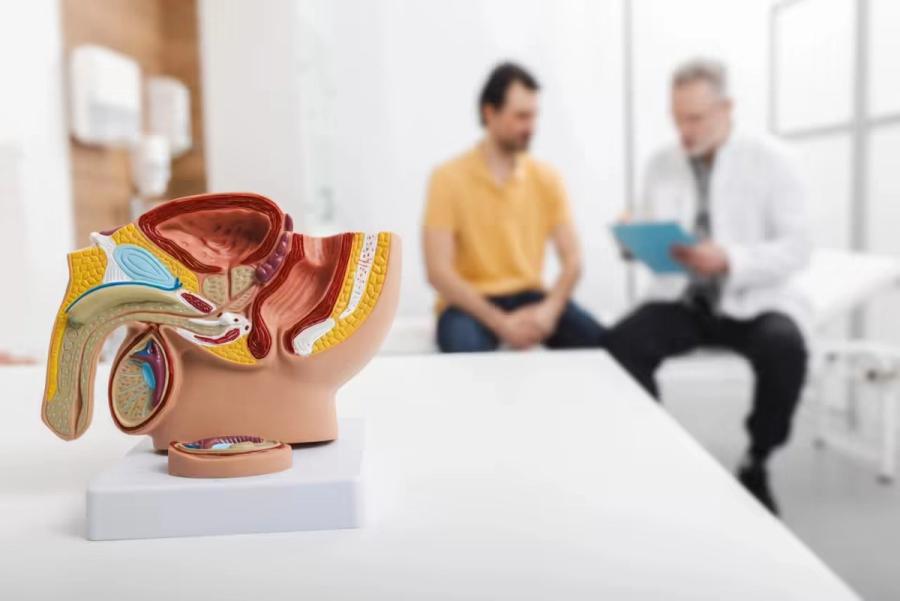
Most patients are referred to Santis by their GP, having already had tests done. You can also book a consultation with us directly if you would prefer, including for a second opinion on a diagnosis made elsewhere.
The consultation takes approximately half an hour. You go through your test results with your appointed consultant surgeon and ask whatever you want to about your health and the options for treating it. If you have not had tests yet, we may carry out a PSA blood test, a rectal examination, an MRI scan or a biopsy to get a clear picture.
- Scenario 1
You have already been diagnosed with prostate cancer
Your consultant surgeon reviews your test results, talks through what they mean and recommends treatment where it is needed. That may be surgery, but other options are available, including surveillance and radiotherapy. Where surgery is recommended, we can usually operate within two to three weeks of your consultation.
- Scenario 2
You have not been diagnosed, but have been referred to discuss test results
Your consultant surgeon can make an informed diagnosis from your results, and may also arrange further tests to give a fuller picture. These can be carried out on site.
Step two
The day of your operation around two hours
If you choose surgery to treat your prostate cancer, a date can usually be scheduled a couple of weeks after your initial consultation. The techniques used are described in full on the robotic prostatectomy, nerve-sparing and da Vinci Single Port pages, and the cost of each is set out on our prices page.
Before the operation
Admission and tests
You are admitted on the day of your operation, having been told when to stop eating and drinking. Pre-assessment tests (blood and urine tests, infection swabs and an ECG) are done one to two weeks beforehand.
Meeting the team
You see both Professor Eden and the anaesthetist before the operation. This is the point to put any last questions to them, and to sign the consent form.
Timing and anaesthetic
Your operation usually starts at either 9am or 1pm and takes around two hours. You are asleep throughout. You are also offered a spinal anaesthetic beforehand, numbing you from the waist down so that you wake comfortable.
Feeling nervous
Do not worry if you are nervous. That is entirely normal. The team have done this operation thousands of times and will take good care of you.
The operation
Keyhole surgery
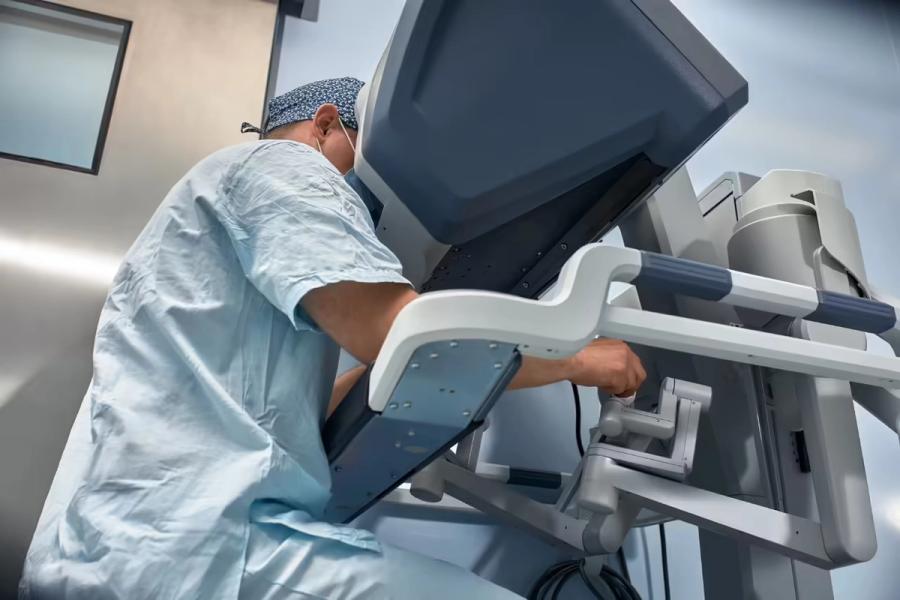
The operation is done by keyhole surgery, through six small incisions in the lower abdomen. Your surgeon operates the instruments through a da Vinci robot, which gives 3D vision, motion scaling and wristed instruments, and with them a precise operation.
Anaesthetic care
A consultant anaesthetist and their assistant keep you asleep throughout, using a combination of drugs given by injection and through a breathing tube.
Nerve sparing
The detail is agreed with you beforehand. The great majority of patients have nerve-sparing surgery, which preserves the nerves that control erections. Patients with more aggressive or bulky tumours may need one or both nerves removed, and where that is anticipated it is discussed with you in advance.
Lymph nodes
If your pre-operative PET CT scan suggests it, some of the pelvic lymph nodes that drain the prostate may be removed. These filter infection and cancer out of the fluid returning to the circulation. You have several hundred of them, so the fluid simply finds another channel. Removing them completes the staging of your cancer and increases the probability of cure.
Removal and repair
Once freed, the prostate is placed intact into a sealed bag inside the abdomen and retrieved at the end, so the cancerous cells never touch healthy tissue. The bladder and the urethra are then joined with stitches, and a catheter is passed through the join and left in place for two weeks while it heals. All stitches, internal and external, dissolve within a few weeks.
After the operation
Coming round
At the end of the operation the anaesthetic drugs are stopped and you gradually wake up.
In recovery
You will probably remember nothing before waking in the recovery room, with an oxygen mask on your face, two drips in your arm and a catheter in place.
At least an hour
You stay there at least an hour before going back to your room, so the team can check that your vital signs are normal, that the catheter is draining well, and that you are comfortable and not feeling sick.
Needing to pass urine
It is normal to feel as though you need to pass urine. That is the catheter, and the surgery on your bladder.
Step three
Recovery and aftercare two days with us, then home
After surgery you spend two days in our care at the hospital before going home. You have your own private room, and can have visitors if you would like them.
The day after surgery
Drips and review
Oxygen tubing and drips come out in the morning, after tea and toast. Your surgeon sees you personally to talk about how you are getting on and how the operation went.
Pain relief
You are given regular painkilling tablets and, if needed, an injection in the arm to thin the blood and prevent clots forming in the legs.
Getting moving
You are encouraged to walk around the ward.
Catheter care
You are shown how to care for your catheter and told what to expect over the next few days, covering blood in the urine, bathing, driving and lifting, in preparation for discharge.
You are discharged at 11am.
Week by week What the first year looks like
Recovery varies from person to person, but a typical path looks like this.
One to two days in hospital, then home with a catheter in place. You will be encouraged to walk for at least 30 minutes each day.
The catheter is removed and activity can be increased. Most men are driving 7 to 10 days after surgery.
A gradual return to most normal activities, avoiding heavy lifting and cycling. Swimming at 2 weeks, running at 3, golf and racquet sports at 4.
Continence and sexual function continue to improve, supported by pelvic floor exercises and follow-up with your care team.
A guide, not a prescription. Your surgeon and care team will give advice tailored to your operation and your recovery.
Follow-up
Why we keep checking your PSA after the prostate has been removed
Most men ask the same thing: if the prostate has been removed, what is the point of another PSA test? Once the prostate is out, PSA should fall to effectively zero. Only tiny amounts are produced by breast tissue and the salivary glands.
If cancer cells left the prostate before the operation and settled elsewhere in the body, they carry on producing PSA wherever they are, and that PSA is detectable in a blood test. So a detectable PSA after a radical prostatectomy is a sign that prostate cancer cells are present, though the test cannot say where they are. An undetectable PSA, less than 0.1 ng/ml, tells you there are no prostate cancer cells anywhere in the body.
The first year
A consultation every three months, covering your most recent PSA result, continence and potency.
Years two to five
The same consultations, at six-monthly intervals.
After five years
You are discharged into the care of your GP, who arranges annual PSA tests.